Thanks to the wonderful capability of Netflix to provide DVDs of otherwise long-forgotten movies, tonight I watched FairyTale: A True Story, which is a 1997 film about Elsie Wright, Frances Griffiths, and the fairies they supposedly found in the bottom of their family's creek bed. Being a family movie of the inspirational variety, the fairies are real in this version, and ultimately bring back Frances's missing father for her (who, surprisingly and inexplicably, is played by Mel Gibson in a 30 second cameo). Obviously, the filmmakers are taking some liberties in calling this a true story - but, the story it's based on is one that is not only true, but fascinating - involving two young girls, Arthur Conan Doyle, and a hoax that wasn't fully debunked until sixty years later, despite its creators being under the age of 16.
In retrospect, I think my first introduction to the Cottingley Fairy story was probably through this FairyTale movie, which came out when I was nine years old. But recently, I came across a podcast by Stuff You Missed in History Class (my favorite podcast-ers) that covered five historical hoaxes, including these silly little fairies. The story essentially goes like this - cousins Elsie and Frances often enjoyed playing down by the creek on Elsie's family's property, and claimed that they saw fairies while they played. One day, they took Elsie's father's camera, and came back with "proof" - a photo of Frances and some fairies dancing by a waterfall. Over the next several years, the girls produced four more photographs, for a total of five pictures proving the existence of fairies.
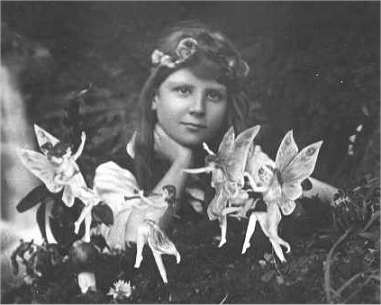 |
| 1917 - Frances and the Fairies |
 |
| 1917 - Elsie and a Gnome |
 |
| 1920 - Frances and the Leaping Fairy |
 |
| 1920 - A Fairy Offers a Poppy to Elsie |
 |
| 1920 - The Fairies and their Sunbath |
Which. Is. Awesome.
Not to burst your bubble, but...the photos were faked. To be honest, I really don't understand why people didn't immediately figure that out, but they were testing for falsified photos in ways that were way above the heads of teenagers - checking for multiple exposures and the like, when in reality, Elsie had copied drawings of fairies out of a storybook onto cardboard, cut them out, and she and Frances stuck them up with hatpins. I guess the photo experts didn't think of that one? But then, this was before the advent of Flat Stanley into pop culture, so maybe it didn't even cross their minds.
But what is especially fascinating to me is that the girls stuck by their story for decades upon decades, and didn't confess that they had faked the photographs until 1983 - that's sixty six years after the first photograph was taken! According to Elsie, everything just got too big to confess that it was all a joke, and the girls were embarrassed to admit the truth with the renowned author of Sherlock Holmes involved in the midst of it. In her own words, Frances said, "I never even thought of it as being a fraud - it was just Elsie and I having a bit of fun and I can't understand to this day why they were taken in - they wanted to be taken in."
In the movie, the spin put on why people were so enraptured by the fairy photographs was because, in a country shaken by World War I, the people needed something hopeful and innocent on which to grasp. And I can see that. I think we can all admit that discovering the existence of fairies would add some brightness to a world that often gets clouded with darkness. Even if the photos weren't real, they managed to bring real joy to people, and that's equally valuable.
And in any case, we always have the 90s movie version if we want the story to end differently. And even to the day she died, Frances insisted that the fifth photograph was not faked. So who knows...maybe I should take my camera with me next time I go walking by the creek.
